Last updated November 17, 2026
ADU Emergency Preparedness Guide for Henderson Homes
When Henderson declared a heat emergency in summer 2023, cooling centers across the valley filled within hours. That day exposed a gap most ADU owners never think about: an ADU tenant who loses air conditioning at 2 a.m. in July is on a different emergency timeline than someone in the main house. They may not know where the sub-panel is, they may not have your number saved under an obvious name, and they may not realize that the unit’s separate utility shut-offs mean the problem can be isolated without touching the main house. This guide covers what a two-household lot actually needs: independent utility shut-offs, a heat protocol written for the ADU, egress you can verify before anyone moves in, fire separation that stays compliant, and a one-page emergency sheet posted inside the unit.
Quick Answer
ADU emergency preparedness in Henderson means treating the unit as its own household: labeling the ADU sub-panel and water shut-off so a tenant can kill power or water without entering the main house, posting a one-page emergency sheet with utility locations and local numbers, verifying bedroom egress windows meet Henderson code before occupancy, maintaining the fire separation between an attached ADU and the main house, and writing a heat-failure plan that tells the tenant when to call NV Energy versus 911.
Table of Contents
- Why an ADU Needs Its Own Emergency Plan
- How to Shut Off Utilities to the ADU Independently
- The Henderson Heat Emergency Protocol for an ADU
- Egress Requirements for ADU Bedrooms in Henderson
- Fire Separation Between an Attached ADU and the Main House
- The One-Page Emergency Sheet to Post Inside the ADU
- Running a Two-Household Emergency Drill
- Common Mistakes to Avoid
Why an ADU Needs Its Own Emergency Plan
A detached or attached ADU is a secondary dwelling with its own utility connections, its own egress points, and often a separate tenant on a lease. That structure changes the math. In the main house, a homeowner knows where the panel is, which breaker feeds the kitchen, and how the water heater behaves. A renter in the backyard unit knows none of that unless someone wrote it down and posted it.
Henderson makes this sharper than most cities. The valley regularly pushes past 110°F in July and August, and the city has activated heat emergency protocols before, opening cooling centers and pushing advisories through Clark County. Southern Nevada also sits in a seismic zone with real, if infrequent, earthquake exposure, and the monsoon season from July through September can drop an inch of rain in under an hour and flood low-lying streets. An ADU tenant facing any of those has one advantage a main-house occupant doesn’t: a smaller, simpler structure to shut down. That advantage disappears if nobody labeled anything.
The other factor is distance. In a large Henderson lot, particularly in neighborhoods like Green Valley Ranch or the older parcels off Lake Mead Parkway, an ADU can sit 80 to 120 feet from the main house. That’s far enough that a tenant shouting for help may not be heard, and far enough that walking over to ask “where’s the shut-off” costs minutes you may not have.
How to Shut Off Utilities to the ADU Independently
The single most useful thing you can do for an ADU tenant is make the unit’s utilities independently controllable. In a properly built ADU, that’s exactly how it should already be wired and plumbed. Verifying it, labeling it, and walking the tenant through it takes about 20 minutes.
The ADU sub-panel disconnect
Most Henderson ADUs are fed from a sub-panel inside the unit or mounted on an exterior wall of the ADU, fed from the main service. That sub-panel should have a main breaker that kills everything in the ADU without affecting the main house. If your unit feeds from a shared panel with no separate disconnect, that’s a genuine safety gap, and it’s the kind of thing a licensed electrician should correct. Don’t open a panel cover yourself to trace circuits; that’s live-work territory.
The ADU water shut-off
Look for a shut-off valve on the line feeding the ADU, typically near where the water line branches off the main service or just inside the ADU’s utility closet. If there isn’t one, a plumber can install one, and it’s worth the cost. In our experience, water damage in an empty ADU is the most common avoidable loss on a two-household lot: a supply line fails at 3 p.m. while the tenant is at work and nobody sees it for six hours.
The gas valve, if applicable
If the ADU has a gas water heater, range, or furnace, there should be a dedicated shut-off valve on the branch feeding the unit. Tag it. If you ever smell gas, the procedure is: leave the unit, don’t flip switches, don’t use a phone inside, get clear, then call 911 and Southwest Gas from outside.
Numbered checklist for labeling day:
- Photograph each shut-off (panel, water valve, gas valve) and print the photos.
- Attach a laminated tag at each location reading what it controls and how to operate it.
- Walk the tenant through each one in person, then have them do it themselves while you watch.
- Note the location of the main house shut-offs too, in case the ADU valve fails.
- Put the same information on the emergency sheet you’ll post inside the unit.
The Henderson Heat Emergency Protocol for an ADU
Heat is the emergency most likely to actually happen in Henderson, and it’s the one most ADU owners have never written a plan for. An HVAC failure in July is not an inconvenience; indoor temperatures in a poorly insulated unit can climb past 95°F within two hours of losing cooling in the afternoon.
What HVAC failure looks like in the first hour:
- The air from the vents runs warm within 10 to 15 minutes of compressor failure.
- Indoor temperature climbs roughly 2 to 4 degrees per hour in a Henderson afternoon depending on insulation and sun exposure.
- A tenant may feel fine until they don’t. Heat exhaustion symptoms (dizziness, nausea, headache, confusion) come on fast above 100°F indoor temperature, and elderly or very young occupants are at higher risk.
Who to call, in order:
- If anyone in the unit shows confusion, fainting, or stopped sweating, call 911. Heat stroke is a medical emergency, full stop.
- If it’s a power outage affecting the neighborhood, report it to NV Energy and check their outage map. Don’t call 911 for an outage.
- If power is fine but the AC isn’t cooling, call your HVAC technician. That’s a repair call, not an emergency services call.
- If cooling will be out for hours during an extreme heat day, get the tenant somewhere cool: a cooling center, a neighbor, the main house if relations allow, or a hotel. Heat kills people who decide to tough it out.
Two cheap additions make a real difference. A battery-powered indoor thermometer the tenant can read at a glance tells them when to act instead of guess. And a written note on the fridge stating “if indoor temp passes 90°F, call [landlord] immediately” removes the hesitation renters often feel about “bothering” the owner.
Egress Requirements for ADU Bedrooms in Henderson
Egress is the code term for a safe way out. In plain terms, every sleeping room in an ADU needs at least one operable window or door that a person can actually climb through, sized and positioned so a firefighter or an occupant can use it. This is checked at permitting and inspection, and it is not something to discover after a tenant moves in.
How to verify a unit meets egress before occupancy:
- Open the bedroom window fully. It should open without a key, without tools, and without removing a screen.
- Check the clear opening. Building code sets minimum width and height for egress openings (typically a 20-inch minimum width and 24-inch minimum height with a net clear opening of about 5.7 square feet for windows), and your Henderson permit documents will state the figure for your unit.
- Check the sill height. A sill higher than about 44 inches above the floor makes escape hard for many people and may need a step or a redesign.
- Make sure nothing blocks the exterior. Furniture, planters, or a fence right outside the window can defeat the whole purpose.
- If the ADU has a garage conversion, confirm the egress window wasn’t compromised by the conversion. This is the single most common egress problem we see on garage conversions in Henderson, because the original overhead door opening gets closed in and the window count drops.
Egress windows also need to stay operable. A window painted shut or swollen from monsoon humidity is a failed egress window, even if it passed inspection two years ago. Test them twice a year, at the same time you change smoke detector batteries.
Fire Separation Between an Attached ADU and the Main House
An attached ADU shares a wall, floor, or ceiling assembly with the main house, and Henderson code requires a fire-rated separation between the two so a fire in one dwelling doesn’t have an open path into the other. That separation is built from specific materials: fire-rated drywall, fire-rated doors, and intumescent seals around door frames that expand under heat to block smoke and flame.
What keeps that separation code-compliant over time, and what quietly breaks it:
- Door hardware: the door between the ADU and main house should be self-closing and latch properly. If it sticks, latch failure means a fire door that’s standing open; that defeats the rating.
- Intumescent seals: check the frame seals annually. Monsoon-season moisture and desert-side dry heat both wear on them, and a cracked or missing seal is a real defect.
- Penetrations: any hole cut through the separation wall for a new outlet, cable, or pipe needs to be sealed with the correct fire-rated material. People drill new holes and forget to seal them. That’s a code failure and a real hazard.
- Drywall integrity: a hole punched in fire-rated drywall between the units breaks the rating. Patch it with the same rated material, not regular drywall.
- Smoke alarms: interconnect the smoke alarms between the ADU and main house where code requires it, and test them monthly. If the ADU has a separate sleeping area, that alarm needs to be loud enough to wake someone behind a closed door.
If you’re not sure what the fire separation assembly in your ADU actually is, your original permit documents will show it. If they’re gone, an inspector can identify it. Fielding ADU Builders pulls permits and passes inspections on every project, so for our own builds the documentation exists and is yours to keep.
The One-Page Emergency Sheet to Post Inside the ADU
Most ADU owners have never made this document. It takes 15 minutes and it’s the highest-value thing on this page. Here’s what belongs on a single sheet, laminated or in a plastic sleeve, posted inside the unit where a tenant will actually see it: inside a kitchen cabinet door or on the wall beside the fridge.
Section 1: Utilities
- Location of the ADU sub-panel and how to kill the main breaker
- Location of the ADU water shut-off and how to close it
- Location of the gas shut-off (if applicable) and a note to evacuate before calling 911 if gas is smelled
- Location of the main house shut-offs, in case the ADU valve fails
Section 2: Emergency numbers
- 911 for fire, medical, or gas smell
- Henderson Police Department non-emergency line for non-urgent police matters
- NV Energy for power outages (and a note not to call 911 for an outage)
- SW Gas for gas emergencies if gas service is present
- Your phone number, written in large print, plus a backup contact
- The nearest cooling center for an extreme heat day
Section 3: Heat protocol
- “If indoor temp passes 90°F, call the landlord. If anyone is confused, dizzy, or has stopped sweating, call 911.”
- Note where the battery thermometer is kept.
Section 4: Egress note
- “In a fire, use the bedroom window if the hallway is blocked. Do not block the window with furniture.”
Give the tenant a copy to keep and post one in the unit. Update it any time you change a system, replace a lock, or change contact numbers.
Running a Two-Household Emergency Drill
A written plan that’s never been walked through isn’t a plan, it’s a document. Twice a year, once before summer heat and once before the winter season, spend 15 minutes on this with the tenant present.
- Walk to the ADU sub-panel together and have the tenant flip the main breaker off and back on. (Do this when the AC and any sensitive electronics are off.)
- Have the tenant close and open the ADU water shut-off while you watch. This is where you find the valve that’s frozen.
- Have the tenant open the bedroom egress window fully and confirm nothing outside blocks it.
- Test the smoke alarms in both dwellings and confirm the tenant knows what they sound like.
- Have the tenant read the emergency sheet aloud. Fix anything that’s stale.
- Walk through the heat protocol: where’s the thermometer, what’s the 90°F trigger, who do they call and in what order.
Do this while you’re also doing routine maintenance, so it doesn’t feel like a separate chore. It’s cheaper than the alternative. Water damage in an ADU runs into the thousands, and a heat emergency that turns into a hospital visit costs far more than the fifteen minutes.
Common Mistakes to Avoid
- Assuming the tenant knows where the shut-offs are. They don’t unless you’ve shown them and posted a sheet. Renters don’t want to call about a “small” problem, so make the sheet explicit that calling is the correct move.
- Not labeling the ADU panel separately from the main house panel. A tenant who kills the main house breaker trying to fix their own AC creates a second emergency instead of solving the first.
- Skipping the egress window check on a garage conversion. In Henderson, garage conversions are the most common ADU format, and the conversion often reduces the number of code-compliant egress openings. Verify before occupancy, not after.
- Letting fire-door hardware fail quietly. A door between the ADU and main house that won’t latch is a fire-separation failure. Check it twice a year.
- Treating a heat emergency the same in both households. An ADU loses cooling faster than the main house if it’s smaller and more exposed, and the tenant has a different set of numbers saved. Write the protocol for the unit.
- Posting the emergency sheet once and never updating it. Change a phone number, replace the water heater, and the sheet is wrong. Review it every season.
- Forgetting the backup plan when the power is out for days. A neighborhood outage affects both households at once. Know the cooling centers and know whether the tenant can shelter in the main house if it comes to that.
When to Call a Professional
Some of this is landlord work you can do yourself: labeling shut-offs, posting the emergency sheet, walking a tenant through the drill. Some of it isn’t. Call a licensed electrician for a panel that has no independent disconnect, a plumber for a missing ADU water shut-off, and a licensed contractor for anything touching the fire separation assembly, egress window sizing, or smoke alarm interconnection. Those are life-safety systems, and the inspection record matters. If you’re not sure whether your ADU’s fire separation and egress actually meet Henderson code, that’s worth having inspected, and that’s the kind of question we answer. Fielding ADU Builders Henderson offers free estimates in Henderson; call (855) 953-5331 to schedule one. The Garrison Standard means a written price before any work starts and a 365-day written guarantee on our work.
Frequently Asked Questions
Yes, if the ADU has its own sub-panel with a main breaker, which is how a properly built ADU should be wired. Find the sub-panel (inside the unit or on an exterior ADU wall), confirm which breaker kills the whole unit, and label it. If there’s no independent disconnect, have a licensed electrician add one.
Every sleeping room in an ADU needs at least one operable window or door that meets code minimums for clear opening width, height, and net clear area, and opens without tools. Your permit documents state the exact figures for your unit. If the ADU is a garage conversion, verify the egress windows weren’t lost in the conversion before a tenant moves in.
Call your HVAC technician if power is fine and the unit simply isn’t cooling. Call NV Energy if the outage affects the neighborhood. Call 911 if anyone in the unit shows confusion, fainting, or stopped sweating, because that’s heat stroke and it needs emergency care. Move the tenant somewhere cool immediately rather than waiting it out.
Check the fire-rated door twice a year to confirm it self-closes and latches, inspect the intumescent seals around the frame for cracks, and make sure any hole cut through the separation wall for wiring or plumbing is sealed with fire-rated material. Patch fire-rated drywall with fire-rated drywall. Test interconnected smoke alarms monthly.
Utility shut-off locations and how to operate them, emergency and non-emergency phone numbers (911, Henderson Police non-emergency, NV Energy, SW Gas if applicable, the landlord, a backup contact, and the nearest cooling center), the heat-failure protocol with the indoor temperature trigger, and a note about using the bedroom egress window in a fire.
Yes. Every ADU and addition we build is permitted, inspected, and handed over with documentation, and our crews are background-checked and in uniform on every job. We work with prefab and modular platforms like Abodu and Cover as well as conventional builds using materials like James Hardie siding, so the utility and safety layout is designed for the two-household reality from day one. Call (855) 953-5331 for a free estimate.
The Bottom Line
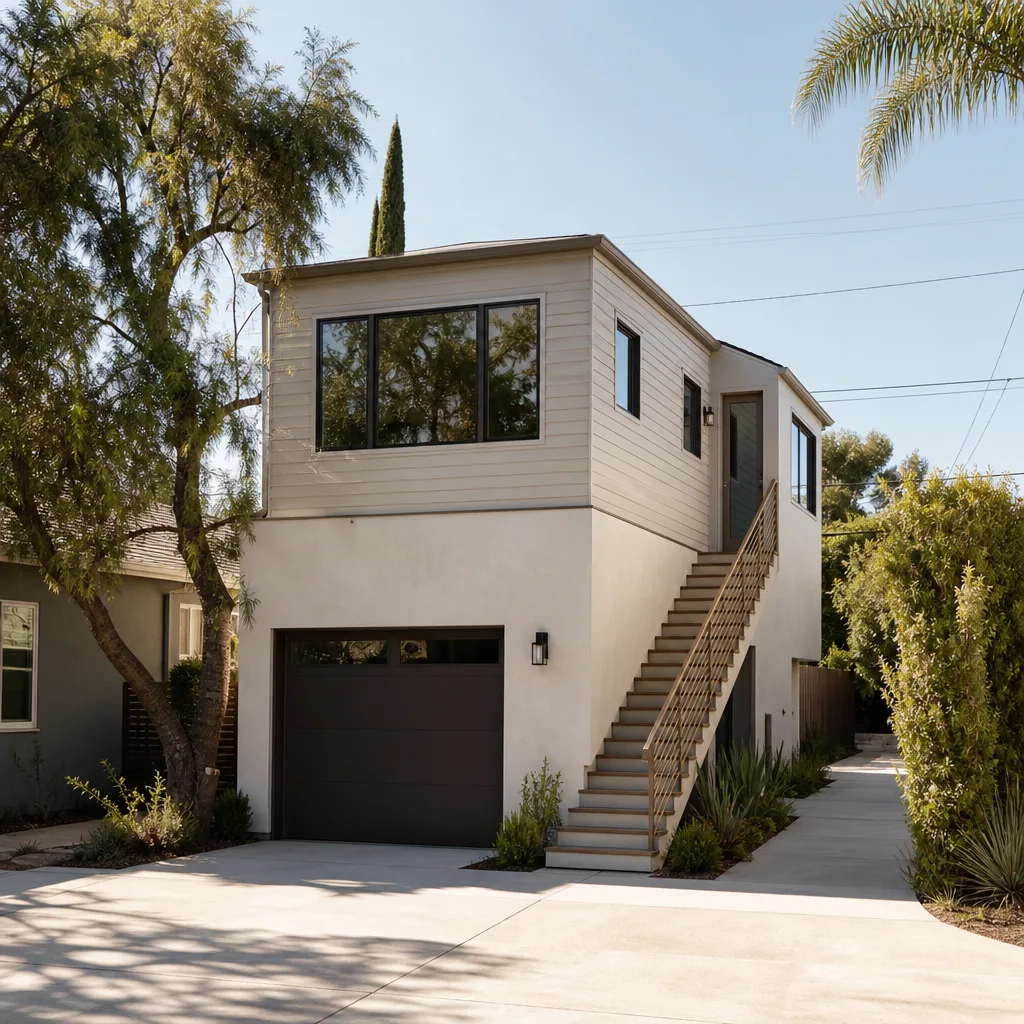
An ADU emergency plan is a two-household plan. Label and verify the unit’s independent power, water, and gas shut-offs. Write a heat protocol for Henderson summers that tells the tenant when to call NV Energy and when to call 911. Confirm the bedroom egress window actually opens and isn’t blocked. Keep the fire-rated door, seals, and drywall intact between the ADU and the main house. And post a one-page emergency sheet inside the unit with utility locations, numbers, and the heat trigger. Fifteen minutes of labeling and a posted sheet are what turn a plan into something a tenant can actually use when it matters. If you want a second set of eyes on your unit’s safety systems, or you’re planning a new ADU, we’re here. Read more about our ADU Builders in Henderson work and our room addition contractor services in Henderson.
If you’re planning a new ADU or converting a garage, start with the garage conversion contractor in Henderson page or return to Fielding ADU Builders Henderson home. Call (855) 953-5331 for a free estimate. Our technicians have up to 20 years of experience, every project comes with a written price before any work starts, and The Garrison Standard covers workmanship defects for 365 days. If something fails, we come back and make it right at no charge.
Written by the team at Fielding ADU Builders Henderson.