
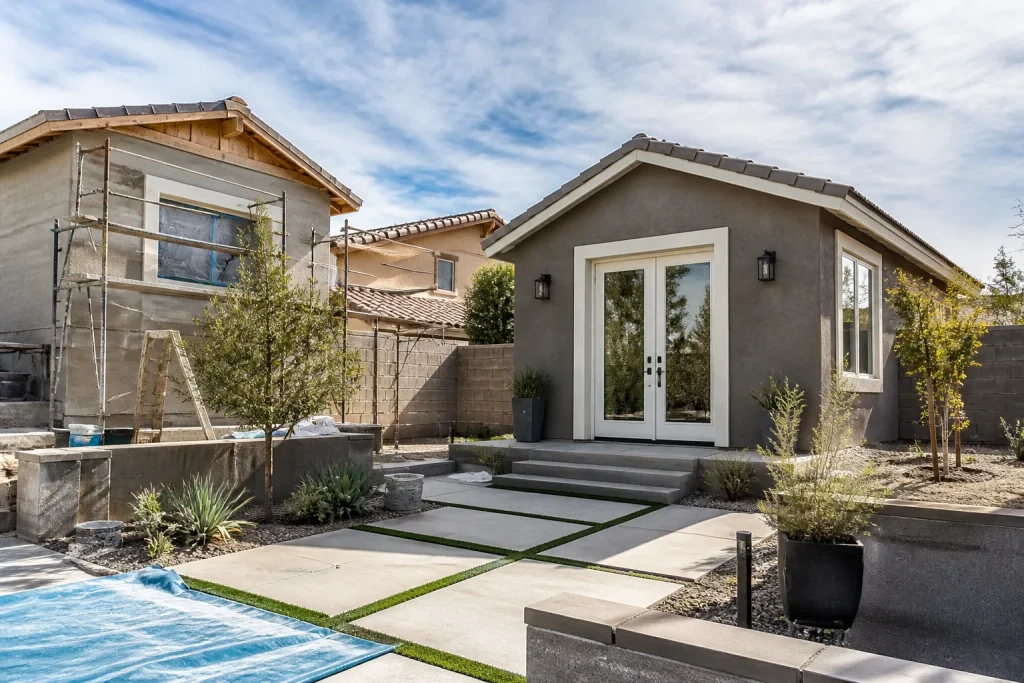
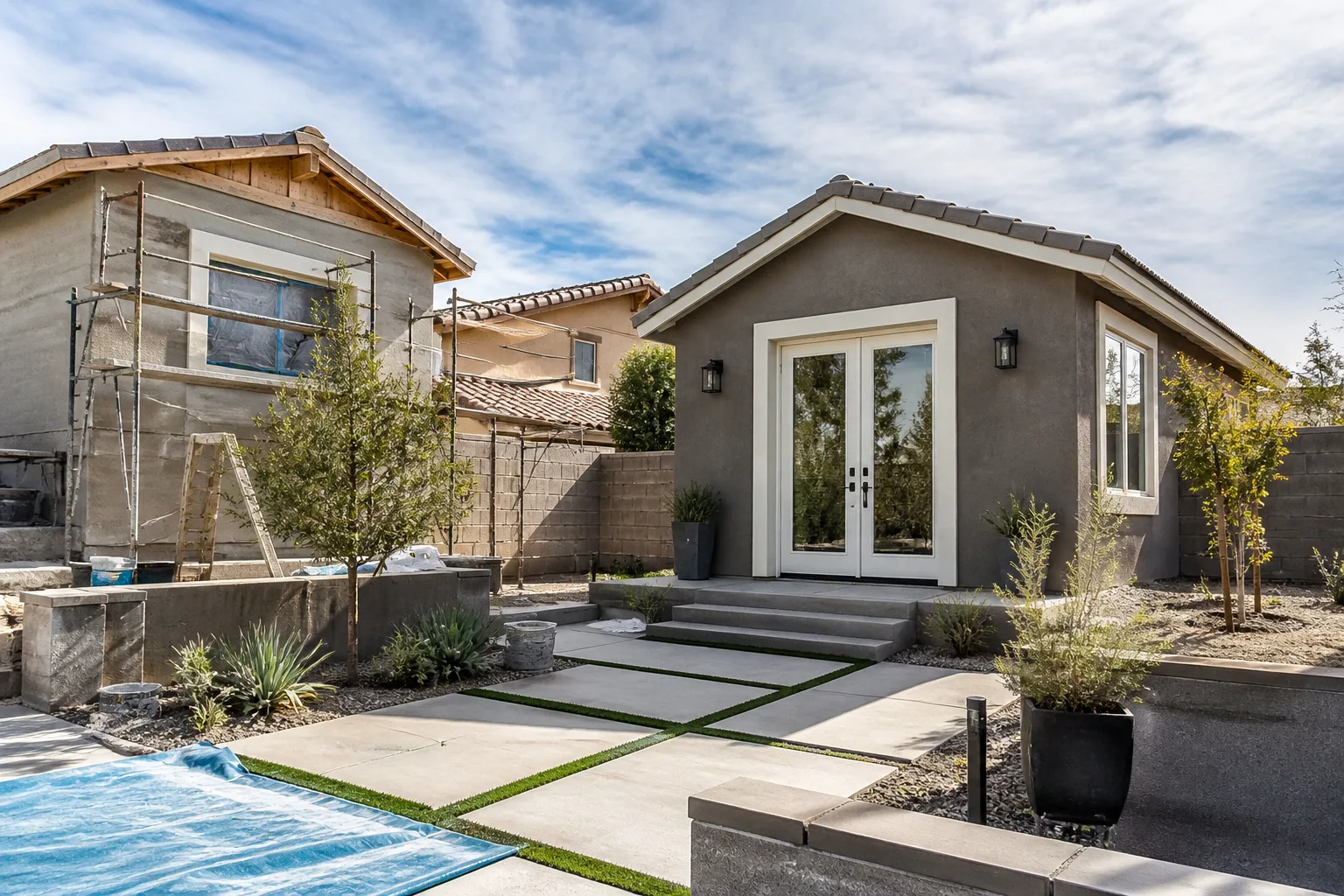
ADU Builders: Repair or Replace? How Henderson Homeowners Decide
A Henderson homeowner who spends $28,000 repairing a 1970s block structure to ADU code can easily spend $12,000 more over five years on the same failing systems they didn’t replace. The repair math looks better on day one and worse every year after. If you own an aging detached workshop or guesthouse inside Henderson’s ADU-eligible zone, the real question isn’t repair versus replace. It’s which path clears permitting fastest and costs least over a ten-year horizon. Here’s the framework we use with homeowners. If you’d rather have someone walk the structure with you, call (855) 953-5331.
Key Takeaways
- Three Nevada-climate conditions kill repair budgets: a failing stem wall, a missing vapor barrier, and original single-pane aluminum frames that can’t meet current energy code.
- Clark County’s renovation pathway can move faster through plan check than new construction, but only when the existing shell passes inspection.
- Compare both paths on cost per square foot, rental income start date, and a line-item written estimate. Anything verbal doesn’t count.
What does the repair-or-replace decision actually cost in Henderson?
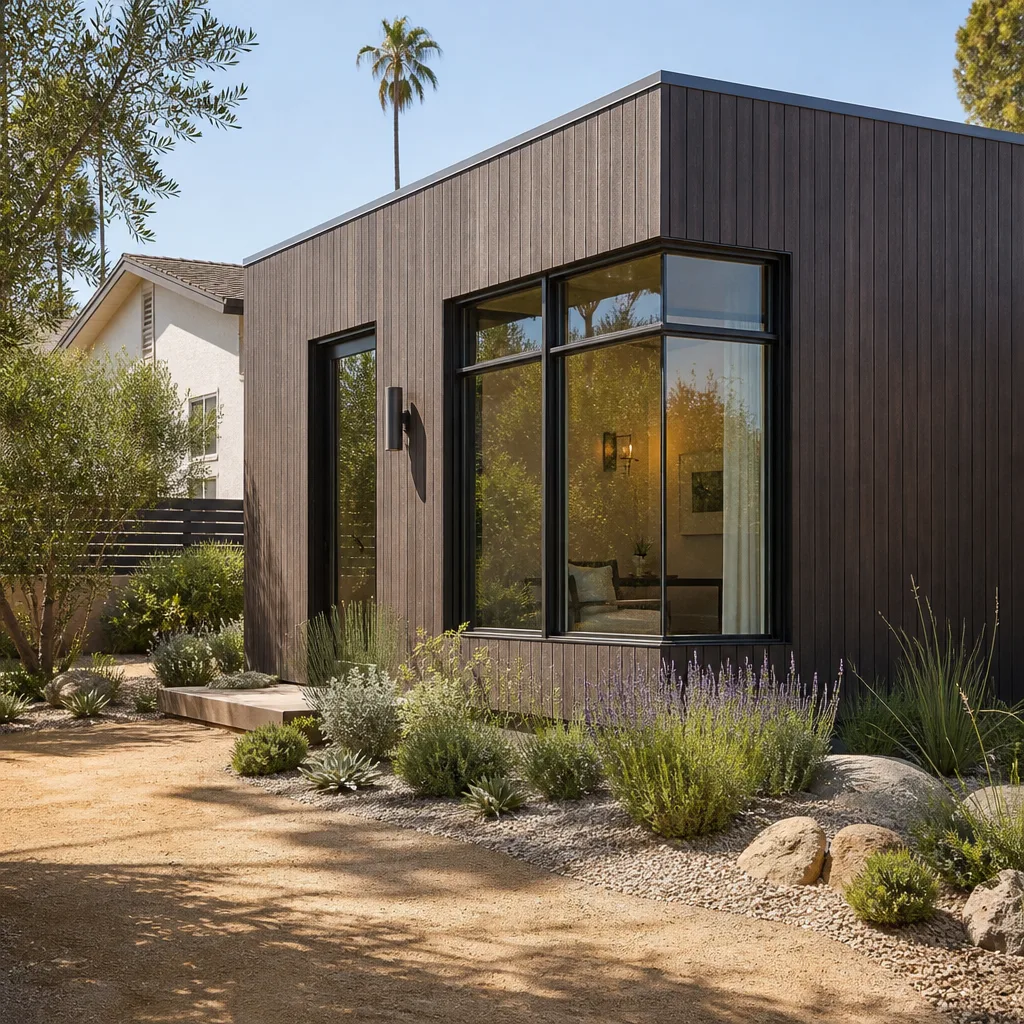
Full replacement of a small detached ADU in the Henderson market typically runs $180 to $280 per square foot for a conventional build, before site work and permit fees. A code-compliant repair of an existing structure often lands at $95 to $150 per square foot, but that number climbs fast once a stem wall or vapor barrier is in scope. A 400-square-foot block guesthouse, then, might come in around $45,000 to $60,000 to repair or $72,000 to $112,000 to replace. The gap narrows every time a repair scope exposes another system.
Here’s the trap we’ve seen plenty of. A homeowner compares a $45,000 repair bid against a $90,000 replacement bid, picks the repair, and never asks whether the repair price included a new vapor barrier or energy-code window upgrades. It usually didn’t. Six years later the same structure needs the systems that should have been replaced the first time.
Before you compare bids, make sure you’re comparing the same scope. A repair quote that ignores the three conditions below isn’t a lower price. It’s a smaller job.
Which structural conditions make repair uneconomical in Nevada’s climate?
Three conditions turn a repair from a smart move into a money pit. Any one of them can push a Henderson repair past the replacement price over a ten-year window. Two of them together usually settles the decision.
- Compromised stem wall. Henderson’s expansive clay soils and the summer heat cycling dry out and swell a foundation with almost no give. A block stem wall poured in the 1970s often has hairline step cracks that mean the foundation can’t carry the lateral load an ADU requires. Naming the problem isn’t the same as fixing it. A structural repair plus underpinning can easily run $18,000 to $35,000 on its own.
- Absent vapor barrier. Nevada’s dry climate doesn’t mean dry slabs. Older detached structures often sit on bare soil with no vapor barrier under the slab. That moisture wicks up through the slab, ruining flooring and feeding mold inside a sealed, conditioned space. Retrofitting a barrier means breaking out the slab. Add $6,000 to $12,000 on a 400-square-foot structure.
- Original single-pane aluminum frames. Those frames and the glass in them won’t meet current energy code for a conditioned dwelling unit. The window package for a small ADU runs $4,500 to $9,000, and the wall framing usually needs work too because the original openings weren’t sized for framing wider than aluminum sliders.
We ran into all three on a block workshop off Lake Mead Parkway last spring. The homeowner had a $26,000 repair bid that covered none of it. When we priced the real scope, the repair came in at $58,000 and replacement at $84,000, so the “cheaper” option had almost vanished. Replacement won, and the homeowner got a brand-new shell with a proper slab, vapor barrier, and James Hardie siding that won’t need repainting for years.
How does Clark County’s ADU permit pathway differ for repairs versus new builds?
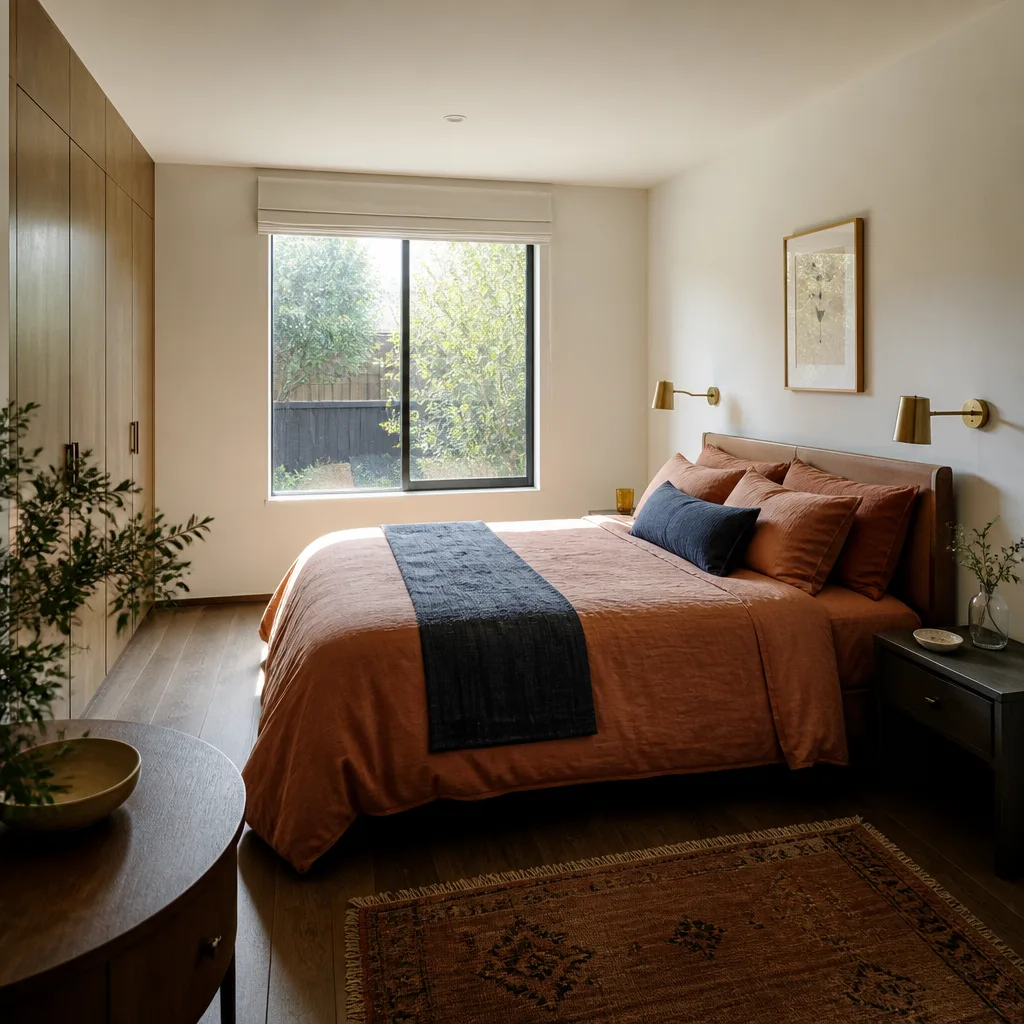
Here’s the part a lot of Henderson homeowners miss: a renovation of an existing structure and a new detached ADU go through different review arcs at Clark County. Neither is universally faster. Which one wins depends on what’s already standing.
A renovation of an existing detached structure is often treated as an alteration with an occupancy change, provided the shell can handle it. The permit review tends to focus on what’s changing, which can mean a shorter plan check. The catch: the county will require the existing structure to be brought up to current code for the new use. A 1970s structure rarely exits that review with a short punch list. One failed inspection on framing or energy compliance sends the plan back to the queue, and that queue doesn’t move on your schedule.
A new detached ADU, by contrast, is reviewed as new construction. Plan check is typically longer because every sheet is reviewed from footing to roof. The payoff is that a new build passes its inspections the first time, because nothing on the plan is fighting an existing structure. No field changes, no re-review.
In our experience in Henderson, the renovation path moves faster on paper but stalls the build schedule more often. The new-construction path is slower to start and less likely to stop. If the existing structure has any of the three conditions above, the fast plan check is a mirage.
Either way, the project needs a written price before any work starts. If a contractor hands you a verbal ballpark for either path, you’re comparing a guess to a guess.
How should you compare the two paths on cost per square foot?
The cleanest comparison is cost per square foot on the finished, code-compliant unit. Not on the work performed. Not on the shell. The finished unit, ready to rent or move a family member into. Here’s a number you can use: a Henderson replacement ADU lands around $180 to $280 per square foot, while a repair only beats that if the existing shell and systems clear the three structural conditions.
Lay out the comparison this way for each path:
- The finished square footage. A repair doesn’t add living space. A replacement might gain a few feet if the lot allows a slightly larger footprint, which spreads the fixed costs over more square feet.
- The total line-item cost. Foundation, framing, envelope, windows, HVAC, electrical, plumbing, finishes, permit fees, and site work. All of it. If a bid has a “miscellaneous” line over $3,000, ask what’s in it.
- Cost per finished square foot. Divide the total by the finished square feet. Compare that number across bids, not the headline.
- The ten-year number. Add expected replacements. A repaired structure with original windows still needs new windows in a decade. The new build doesn’t.
If the repair wins on the ten-year number, repair is the right call. It’s usually the wrong call in Henderson when the stem wall and vapor barrier both come up.
How does the decision affect your rental income timeline?
This is the variable homeowners underweight most. A repair that clears permits and inspections in three months beats a rebuild that takes four months, even at a lower square-foot cost, because rent starts sooner. A repair that fails two inspections and drags to seven or eight months loses to the rebuild, and it usually costs more, too.
Say the ADU would rent for $1,600 a month in Henderson. A rebuild that delivers in four months loses four months of rent, or $6,400. A repair that flunks inspections and takes eight months loses $12,800. The repair bid might look cheaper on paper, but the schedule gap buries the difference. A phone that rings on a failed inspection is the expensive part of a repair.
When you’re weighing the two, ask each contractor for their expected inspection count and the failure risk on the existing structure. A contractor building a new ADU using a prefab platform like Plant Prefab or Abodu usually has a tighter inspection sequence, because the modules are built in the shop and inspected there. That’s a real schedule advantage, even with a longer plan-check turnaround.
What should a written estimate for each path itemize?
A written estimate has to give you the same line items for both paths, or you can’t compare them. If a contractor won’t itemize, that’s your answer. Here’s what to insist on, for a Henderson repair or a new build:
- Demo and disposal, priced separately from construction.
- Foundation or stem wall scope, with a note on whether underpinning is included or excluded.
- Vapor barrier and slab work, listed as its own line.
- Window package, with the energy-code rating stated.
- HVAC, electrical, and plumbing allowances, each with a number.
- Permit fees, stated as a pass-through or a fixed line.
- A line for site work: grading, drainage, and any utility trenching.
- The warranty in writing, with what it covers and how long it runs.
One more test: a contractor offering a verbal recommendation should still hand you a written price before a single nail is driven. We put the price in writing before any work starts and stand behind the work for a full year. If the work fails in that year, we come back and make it right at no charge. That’s The Garrison Standard, and it applies to both paths.
When should you call a professional instead of deciding on your own?
It’s time to call when you can’t tell by looking whether the stem wall is cracked or a vapor barrier is missing. That’s most homeowners, and it’s not a failing. Those conditions hide under flooring and behind stucco. The 365-Day Done Right Promise covers the work we do, not the guesses you’d make before we do it. We’ve pulled our share of these apart and can usually tell within an hour’s walk-around whether repair pencils or not.
There’s also a safety piece worth naming. If the existing structure has roof framing that’s been altered, or a masonry wall with visible separation at a corner, don’t poke around on it. Get a professional to look before you spend a dollar on a repair scope.
Related services in Henderson: if your project is a garage conversion, see our Garage Conversion Contractor in Henderson page. If you’re adding living space to the main house, our Room Addition Contractor in Henderson page covers that. And for the full range of detached ADU work, visit ADU Builders in Henderson or Fielding ADU Builders Henderson home.
The Bottom Line
Most Henderson homeowners should repair only when the existing structure clears all three conditions: sound stem wall, present vapor barrier, and window frames that meet current energy code. If any of the three fail, replacement usually wins on the ten-year number, even though it loses on day-one math. Compare both paths on cost per finished square foot and on rental income start date, and get a line-item written price for each. If you’re in Henderson and need help deciding, Fielding ADU Builders Henderson offers free estimates. Call (855) 953-5331.
Frequently Asked Questions
Repair is cheaper only when the existing stem wall, vapor barrier, and window frames pass current code. In most 1970s Henderson structures, at least one of those three fails, which pushes the repair scope close to the replacement cost. Get a line-item estimate for both before you decide. Call (855) 953-5331 for an exact quote on your structure.
Plan check for a renovation usually runs shorter than for new construction because reviewers focus on the change, not the whole building. But renovations fail inspections more often because the old structure has to be brought up to code. Expect a faster start and more stops on a repair, and a slower start with a cleaner run on a new build. Call us for a free walk-through and we’ll tell you which path fits your lot.
Both a repair and a rebuild can change your assessed value, because the finished dwelling unit has to be accounted for either way. Insurance on a new structure is usually lower than on an aging one that’s been patched repeatedly. Ask your insurer for a quote on both scenarios before committing. For a written estimate on the construction side, call (855) 953-5331.
Yes. Any ADU work we build is permitted, inspected, and closed out in your name through Clark County. A contractor who offers to skip the permit is telling you they’ll skip the inspection too. Call (855) 953-5331 to schedule your free estimate, and we’ll walk you through the permit steps on each path.
Written by the team at Fielding ADU Builders Henderson.
Need ADU Help?
Call Fielding ADU Builders Henderson - licensed & insured, here with fast after-hours help in Henderson.
(855) 953-5331