Last updated November 17, 2026
How to Hire an ADU Contractor in Henderson: A Step-by-Step Guide
Nevada’s contractor licensing board logs hundreds of complaints against residential contractors every year, and the homeowners who file them almost always skipped the same two verification steps before writing the first check. They never confirmed the license was active, and they never got a written fixed price before the deposit cleared. This guide is built around the leverage you actually have in Henderson before you sign anything: the paper trail, the permit name, and the draw schedule. You’ll learn how to check a Nevada license in three minutes, which contract clauses protect you if work stalls, and how to spot the allowances that make an ADU bid look cheaper than it is.
Quick Answer
To hire an ADU contractor in Henderson, verify the contractor’s Nevada license is active on the NSCB portal, confirm in writing who pulls the permit and who is physically on-site, and sign a fixed-price contract with a draw schedule tied to inspected work rather than dates. Get every allowance and permit fee in writing before you sign. That sequence, done in that order, weeds out most of the contractors who disappear after the deposit.
Table of Contents
- How Do You Verify a Nevada Contractor License?
- Who Pulls the Permit, and Who Is Actually on Site?
- What a Fixed-Price Contract Must Include
- How to Structure a Draw Schedule
- ADU Bid Red Flags That Look Like Savings
- What Henderson Lots and Codes Mean for Your ADU
- Choosing Between Prefab, Modular and Conventional
- What a Workmanship Guarantee Should Say
How Do You Verify a Nevada Contractor License?
You check it on the Nevada State Contractors Board portal, and it takes under three minutes once you know what you’re looking for. The NSCB keeps a public license search at nscb.nv.gov. You need the license number from the contractor’s bid or business card, or their business name. That search tells you whether the license is active, what classifications it holds, whether there are disciplinary actions on record, and who the qualifier is.
“Active” versus “inactive” is not a technicality. An inactive license means the contractor is not currently authorized to contract for work in Nevada. If the status reads inactive and someone is handing you a bid, that alone is a stop sign. The classifications matter too: residential work falls under specific classifications, and an ADU is residential construction. A license that’s active but doesn’t cover the scope you’re hiring for is just as much a problem.
Here’s the sequence we recommend every Henderson homeowner run before the first check:
- Pull the license number off the bid and search it on the NSCB portal. Confirm status reads active.
- Check the classification covers residential construction, not just specialty trades.
- Look for disciplinary actions or complaints on the record. Read them, don’t just count them.
- Confirm the business name on the license matches the name on your contract exactly.
- Save a screenshot of the search results with the date. It’s your record if things go sideways.
One more step most guides skip: ask for the qualifier’s name and confirm it matches the license record. The qualifier is the person whose license the company operates under. In Henderson, ADU projects often get subcontracted in ways that put a different name on the actual work than the name on your contract. That’s the next section.
Who Pulls the Permit, and Who Is Actually on Site?
The name on the permit should be the name on your contract. That’s the short answer. Henderson allows subcontracting arrangements on residential projects, and those arrangements can shift liability away from the general contractor whose name you signed with. If the permit lists a subcontractor and your contract lists a general contractor, ask exactly who is responsible if the inspection fails or the work fails later.
Ask these questions in writing before you sign:
- Who is the contractor of record on the permit? Get the license number that will appear on the permit application.
- Which portions of the work will be subcontracted? Framing, electrical, plumbing, and HVAC are common ones. Ask for the names of the subs and their license numbers.
- Who is physically on site day to day? A superintendent, a lead, or the qualifier themselves. If the answer is “whoever’s available,” that’s your answer.
- Who do I call when something’s wrong? Get a name and a phone number, and confirm the phone is answered by a person, not a voicemail queue.
Why this matters for an ADU specifically: an accessory dwelling unit involves multiple trades and often a separate utility connection. The more subtrades, the more places liability can drift. A permit pulled by the entity doing the work keeps the inspection chain clean. When you’re comparing ADU builders in Henderson, this is the question that separates a real general contractor from a broker of labor.
We work with major prefab platforms including Abodu, Cover, and Mighty Buildings, and with those builds the site-work scope (foundation, utilities, connections) is where responsibility most often gets fuzzy. Nail down who owns each piece before you sign.
What a Fixed-Price Contract Must Include
A written, fixed-price contract in Nevada should state the total price, a detailed scope of work, a payment schedule tied to milestones, and the license number of the contractor. Beyond that, four clauses show up in good contracts and go missing in bad ones. Ask for all four.
- A clause stating the price is fixed and what constitutes a change order. Change orders should be in writing and signed by you before extra work happens. This is how you avoid the price moving after the first nail is driven.
- A written schedule with milestone dates. Not just a completion date. Foundation, framing, rough-in, inspection, finish. Dates you can hold someone to.
- A warranty clause spelling out what’s covered, for how long, and how a repair gets scheduled. A one-year workmanship guarantee in writing is standard for a serious builder. If it’s a verbal promise, it isn’t a guarantee.
- A dispute and termination clause. What happens if work stops. How you can terminate and what you’re owed. Most residential contracts omit this entirely.
Read the contract for what’s missing, not just what’s there. The absence of a change-order clause is the most expensive silence in the document. If a contractor won’t put these clauses in writing, that tells you something about how they’ll handle a problem mid-build.
How to Structure a Draw Schedule
Money should follow completed, inspected work, not the calendar. That’s the whole principle. A draw schedule that pays on dates rewards the wrong behavior. A draw schedule that pays on inspected milestones keeps your money and the work in step.
A draw schedule that protects you looks roughly like this, though the percentages shift with project size:
- Deposit: small and tied to mobilization. Large upfront deposits are where homeowners get stranded.
- Draw 2: released after foundation and framing pass inspection.
- Draw 3: released after rough-in (electrical, plumbing, HVAC) passes inspection.
- Draw 4: released after final finish work and final inspection.
- Final payment: held until you’ve walked the unit and the punch list is done.
The exact structure depends on your contract, but the principle holds: a draw gets released when an inspection is passed, and you confirm it passed. Ask to see the inspection record before each draw. In Henderson, inspections are scheduled through the city, and you can confirm the pass yourself rather than taking a text message as proof.
If you’re doing a garage conversion in Henderson, the schedule is tighter but the logic is identical. Wiring, insulation, and a separate utility run all need inspection before they’re covered by drywall. Once the drywall’s up, the inspection is either done or it’s a problem.
The reason this matters: disputes almost always start with a payment made ahead of the work. A draw schedule that won’t release money until work is inspected removes that whole category of argument.
ADU Bid Red Flags That Look Like Savings
Some bids come in cheaper because they leave work out. Here are the specific things to look for in an ADU bid, and what each one costs you later if it’s missing:
- Vague allowances for utility connections. “Allowance: $8,000 for utilities” can mean almost anything. A separate ADU meter, trenching across the yard, or an upgraded panel can run well past a stated allowance. Ask for the connection scope in writing, with a line item for each utility.
- Missing engineering line items. An ADU needs structural engineering, and prefab units need foundation and site engineering for your specific lot. If the bid has no engineering line, the cost is either hidden in a lump sum or missing. Ask where it is.
- Permit fees excluded as a “cost-saver.” A bid that excludes permit fees isn’t cheaper; it’s a bid with a bill attached later. Some contractors exclude fees so the top-line number looks lower than the next bid. Compare bids on total cost including permits, engineering, and utility connections.
- No line item for site work. Grading, drainage, and access for a unit in your backyard are real costs. A bid without them isn’t finished.
- Finishes quoted as a range rather than a number. A range means you get the low end and pay for anything above it.
A bid you can compare is a bid you can price. When you compare ADU builders in Henderson, ask each one to break out permits, engineering, utility connections, and finish selections as separate lines. That single request flattens the market and makes the honest bids obvious.
What Henderson Lots and Codes Mean for Your ADU
Henderson’s lot sizes and code rules shape what you can actually build, and getting this wrong wastes months. Many Henderson neighborhoods sit on lots where an ADU fits comfortably; some don’t, and the setback and lot-coverage rules decide it before you pick a unit. A setback variance is the city’s written permission to build closer to the property line than the standard rule allows. It takes time to get and it changes your budget. Know whether you need one before you sign a construction contract.
Henderson’s climate affects the build more than most homeowners expect. Summer heat drives cooling loads, so the ADU’s insulation, window selection, and HVAC sizing matter more here than they would in a milder climate. A unit that’s comfortable in a mild climate with a smaller system may need a larger one in Henderson. That cost should be in the bid, not discovered at the end.
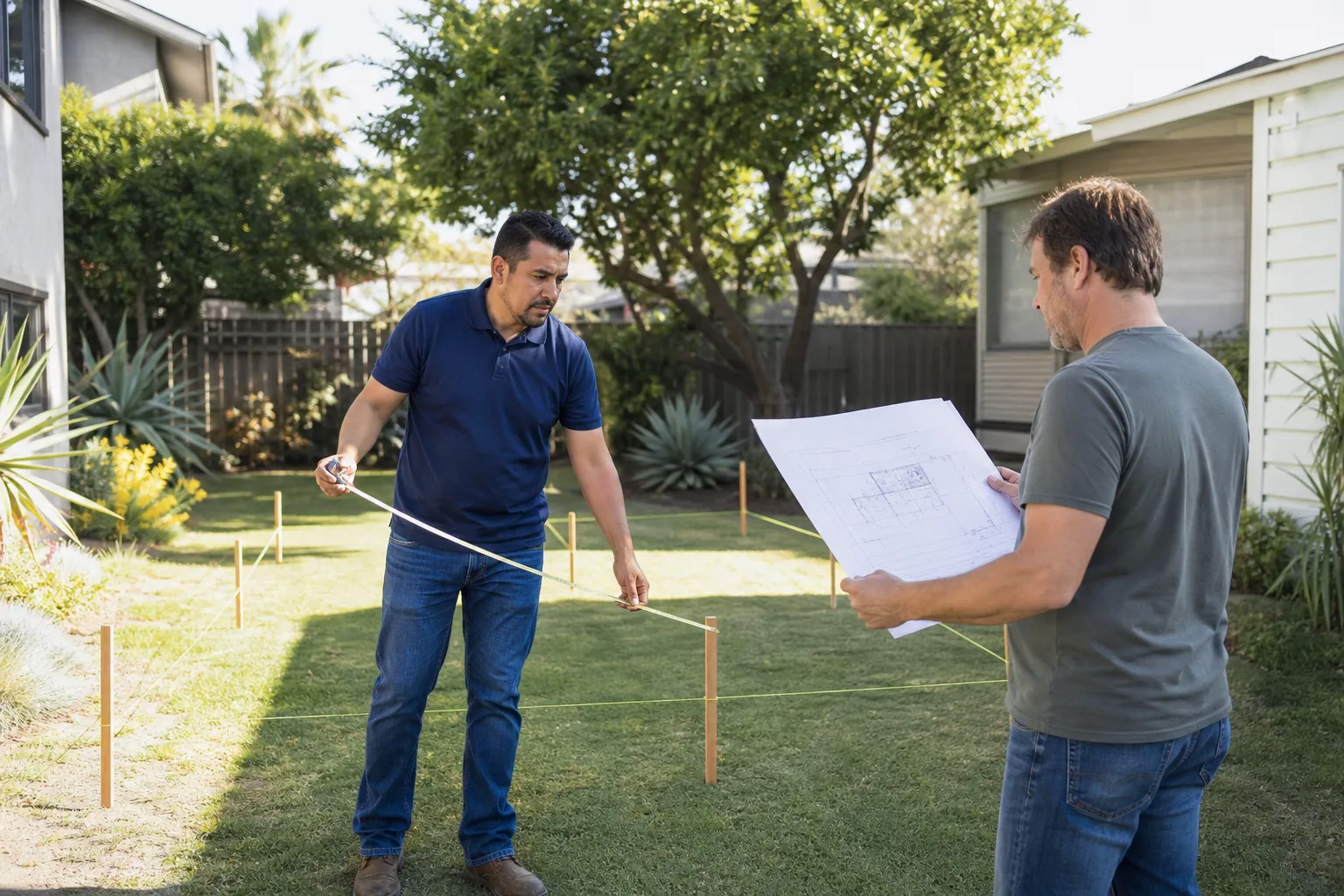
In our experience, the Henderson projects that run smoothly are the ones where the contractor walked the lot before pricing. Ask for a site visit before the bid, not after. Yard access, slope, and existing utility runs are all visible on a walk-through and all invisible on a phone quote.
Choosing Between Prefab, Modular and Conventional
The right build method depends on your lot, your budget, and how fast you want the unit usable. Henderson homeowners have three broad paths, and each has a different cost curve:
- Prefab and modular ADUs. Units from platforms like Boxabl and Plant Prefab arrive largely built, which shortens on-site construction. The site work (foundation, utilities, connections) still has to happen and still has to be permitted. Do not let a prefab quote hide the site-work scope.
- Stick-built construction. Built on your lot, with materials like James Hardie siding and finishes chosen to match your house. More flexible for unusual lots and more costly in time.
- Garage conversions. The fastest and least expensive path for most Henderson homeowners, because the structure and utilities are already there. The trade-off is that you give up the garage.
We work with Abodu, Cover, Dvele, Mighty Buildings, Boxabl, and Plant Prefab on the prefab side, and with conventional builds using James Hardie siding and Tuff Shed-style structures on the other. The point of knowing these options isn’t brand loyalty; it’s matching the right method to your lot and budget so you’re not paying for a method that doesn’t fit. A conversation about room additions in Henderson often starts with the same question: prefab or conventional, and the answer depends on what’s already on the property.
What a Workmanship Guarantee Should Say
A workmanship guarantee should spell out what it covers, how long it runs, and how a repair gets scheduled. Vague “warranty” language means nothing when a door sticks or a foundation cracks. The Garrison Standard covers workmanship defects for 365 days; if something fails, we come back and make it right at no charge. That’s the level of specificity to demand from any contractor you hire in Henderson: a written term, a written scope, and a written process for the repair visit.
Ask for the guarantee in writing, read it, and keep it with your contract. The contractors who won’t hand you one are the ones you want to know about before you sign, not after.
Common Mistakes to Avoid
- Skipping the NSCB search. The portal exists, it’s free, and it takes three minutes. The homeowners who get burned almost always skipped it.
- Accepting a verbal price. The number that matters is the one in writing before work starts, not the one said on the phone. Get it in writing, every time.
- Comparing bids on the top-line number only. One bid may exclude permit fees, engineering, and utility connections that another includes. Compare totals, not headlines.
- Paying a large deposit upfront. A big deposit before mobilization puts your money ahead of the work. Keep the first payment small and tied to mobilization and permits.
- Not asking who’s on site. In Henderson, subcontracting is allowed, and it can move liability off the contractor whose name is on your contract. Ask for the names and license numbers of subs.
- Ignoring the lot before pricing. Setbacks, drainage, and access are lot-specific. A bid without a site visit is a guess.
- Not confirming inspections passed. Inspections are public. Confirm them yourself before releasing each draw rather than trusting a text message.
When to Call a Professional
Call a licensed contractor the moment your plan involves a permit, a structural change, or a new utility connection. That covers every ADU and most garage conversions, because a habitable space needs permits and inspection. It also covers anything involving electrical panel work, gas lines, or modifications to a load-bearing wall. These aren’t tasks to take on yourself, even with good instructions. Panel upgrades and gas work are genuinely dangerous, and a permit pulled by a licensed contractor is what makes the work insurable and inspectable. Even a prefab unit requires a foundation and site work that must be permitted and inspected on your specific lot. If you’re unsure whether your project needs a permit, the answer is almost always yes, and a quick call settles it.
Fielding ADU Builders Henderson offers free estimates in Henderson. Call (855) 953-5331.
Frequently Asked Questions
Search the contractor’s license number on the Nevada State Contractors Board portal at nscb.nv.gov and confirm the status reads active. The portal also shows the license classifications, any disciplinary actions, and who the qualifier is. Confirm the business name on the license matches the name on your contract before you sign.
The contractor of record on your contract should be the name on the permit. Henderson allows subcontracting arrangements, so ask in writing which portions of the work will be subcontracted and who will be listed as the contractor of record on the permit application. The name on the permit and the name on your contract should match.
A fixed-price contract should state the total price, a detailed scope of work, a payment schedule tied to milestones, and the contractor’s license number. Ask specifically for a change-order clause, a milestone schedule, a written warranty clause, and a termination clause. Those last four are the ones most residential contracts omit, and they’re the ones that protect you if work stalls.
Release money when work is completed and inspected, not on calendar dates. Keep the initial deposit small and tied to mobilization, then release draws after foundation, framing, and rough-in inspections pass. Hold final payment until you’ve walked the completed unit and the punch list is closed. Confirm each inspection pass yourself before releasing a draw.
Bids differ mostly because they include different things. Some exclude permit fees, engineering line items, and utility connection scope as a way to look cheaper on the top line. Ask each contractor to break permits, engineering, utility connections, and finishes into separate lines, then compare totals. The cheapest bid is often the one with the most work left out.
A workmanship guarantee needs three things: what it covers, how long it runs, and how a repair visit gets scheduled. The Garrison Standard covers workmanship defects for 365 days and spells out that if something fails, we come back and make it right at no charge. Ask for the guarantee in writing and keep it with your contract. Call (855) 953-5331 for an exact quote on your project; estimates are free.
The Bottom Line
Hiring an ADU contractor in Henderson comes down to a paper trail you build before you sign. Verify the license is active on the NSCB portal. Confirm who pulls the permit and who’s physically on site. Sign a fixed-price contract with a change-order clause, a milestone schedule, a written guarantee, and a termination clause. Tie your draw schedule to inspected work instead of dates. And compare bids on total cost, with permits, engineering, and utility connections named as line items. Do those five things and most of the contractors who disappear after the deposit quietly remove themselves from your shortlist.
If you’d rather price your project with a written number in hand before you commit to anything, call Fielding ADU Builders Henderson at (855) 953-5331 to schedule your free estimate. We put the price in writing before any work starts, and every build is backed by The Garrison Standard: if the work isn’t done right, we come back and make it right at no charge. Start with our Fielding ADU Builders Henderson home page for the full picture of what we build.
Written by the team at Fielding ADU Builders Henderson.